There is an official video of the current exhibition Fashioning Fashion at the DHM in Berlin. For everyone interested or curious. This little documentary is also part of the exhibition itself.

Showing posts with label 18th century fashion. Show all posts
Showing posts with label 18th century fashion. Show all posts
Friday, May 11, 2012
Video zur Ausstellung Fashioning Fashion im DHM
Es gibt bei youtube ein Video der Aufbauarbeiten und zur Konzeption der aktuellen Ausstellung im DHM in Berlin. Für alle, die nicht hinfahren können oder ein kleines preview möchten. Der gleiche Film wird übrigens auch innerhalb der Ausstellung gezeigt.
There is an official video of the current exhibition Fashioning Fashion at the DHM in Berlin. For everyone interested or curious. This little documentary is also part of the exhibition itself.
There is an official video of the current exhibition Fashioning Fashion at the DHM in Berlin. For everyone interested or curious. This little documentary is also part of the exhibition itself.

Thursday, May 10, 2012
18th century 'fingertipless' gloves?

Beim näheren Betrachten stellt sich zudem der Eindruck ein, die offenen Spitzen gebe es nur an der rechten Hand. An der linken Hand sieht der Handschuh am sichtbaren Zeigefinger geschlossen aus. Könnte es eine spezielle Handbekleidung zum Musikmachen sein? Oder zumindest für eine Tätigkeit, die nur die rechte Hand beansprucht (im Rahmen eines Maskenballs?)
Fragen über Fragen, auf die vielleicht jemand eine Antwort hat? Über Hinweise freue ich mich natürlich sehr!

Also it seems as if only the right hand has opened fingertips while the left looks completely covered.
So were they used for music making, maybe? Or any other purpose that mainly required the use of the right hand in a rather delicate manner? I have no idea... and will be happy about any suggestions!
Monday, May 7, 2012
Endlich schlechtes Wetter...
...und endlich wieder Zeit und Muße für Nadel- und Stickarbeit. Dieser post dient lediglich als Beweis, dass sich tatsächlich mal wieder etwas getan hat bei mir, als eine Art Selbstmotivation. Vielleicht werde ich ja noch dieses Jahr fertig? ; )


Es gibt noch eine Unmenge zu tun. Und vermutlich wird das Drapieren am Rücken wieder ein ewiges Gefummele. Der Taft ist diesmal sehr fein und steht nicht so schön wie der bei meiner Francaise. Aber immerhin geht es wieder weiter!
It was about time to continue with my Anglaise and the rainy weekend helped a little. There is still a lot to do and I can already see my self arranging those back pleats over and over again. But who knows, I might even be able to finish the dress this year! ; )


Es gibt noch eine Unmenge zu tun. Und vermutlich wird das Drapieren am Rücken wieder ein ewiges Gefummele. Der Taft ist diesmal sehr fein und steht nicht so schön wie der bei meiner Francaise. Aber immerhin geht es wieder weiter!
It was about time to continue with my Anglaise and the rainy weekend helped a little. There is still a lot to do and I can already see my self arranging those back pleats over and over again. But who knows, I might even be able to finish the dress this year! ; )
Monday, April 30, 2012
Fashioning Fashion im Deutschen Historischen Museum
 |
| © LesMads |
 |
| © Phaidon |
Wie zu erwarten, gab es ein Fotoverbot, aber an dieser Stelle gibt es eine nette kleine Fotostrecke aus dem DHM.

I grabbed the first opportunity to visit the exhibition Fashioning Fashion at the German Historical Museum in Berlin this past weekend. Knowing the English publication of Fashioning Fashion inside out, I was looking forward to see some of my favourite garments en nature, such as the lovely Redingote (see picture at right).
Die Ausstellung gibt einen schönen Überblick über die Entwicklung der Mode in den Jahren 1700 bis 1915. Anhand von vier unterschiedichen Kategorien werden die Museumsbesucher an die Besonderheiten der historischen Kleidung herangeführt:
Die erste dieser Kategorien ist die Silhouette. Anhand dieser werden die wichtigsten Entwicklungschritte in der Herren- und Damenmode mittels repräsentativer Exemplare in einer Art Zeitstrahl vorgestellt. Daran schließt sich die zweite Kategorie Textur /Textilien an und stellt einige besonders aufwendige und typische Web-, Färbe- oder Drucktechniken der Modegeschichte vor, wiederum anhand von sehr schönen erhaltenen Originalen.
Die dritte Kategorie widmet sich der Form, wobei natürlich in erster Linie originale Paniers, Schnürleiber und Korsetts, Krinolinen und Turnüren gezeigt werden.
Die vierte und letzte Kategorie stellt wunderschöne Beispiele der Dekoration vor, Spitzen, Stickereien, Drapierungen und natürlich diverse Accessoires wie Schmuck, Fächer, Reticules oder Hüte.
The exhibtion offers an interesting overview of the changing European fashions between 1700 and 1915 by arranging the exhibits under four different topics. The first one is dedicated to the silhouette, exhibiting male and female fashion according to a time bar with some very pretty and typical samples. The second shows some beautiful textiles and the weaving, colouring and printing techniques that went along with the development of these textiles. The third topic is the form, which - of course - involves the corsets and paniers, the crinolines and bustles. The fourth and final topic is the trim and decoration. Here you get a closer look at historical laces and embroidery, at fans, reticules and hats.

The relative darkness and the safety distance both make it hard to really examine the exhibits in detail. But you get a good look at the embroideries in the fourth fraction, since almost all samples in that part of the exhibition are behind glass.
Was mir in erster Linie wieder auffiel, war die Zierlichkeit der erhaltenen Damenmode, die sich größtenteils wie Puppenkleidung ausnahm, so klein und schmal wirkten einige der Originale. Diese Taillen! Hätte ich die Gelegenheit gehabt, mich auf die Podeste neben die Exponate zu stellen, hätte ich einen Großteil mit Sicherheit um mehr als einen Kopf überragt.
Again, what astounded me the most was the delicate tininess of the garments, especially the female ones. Compared to me they almost looked like doll dresses. And don't ask me about some of the waists I have seen there!
The exhibtion opens until Juli 29th, 2012.
Die Ausstellung läuft noch bis zum 29. Juli 2012.
Wednesday, March 21, 2012
Frühlingsgefühle...

Fashioning Fashion: Eine Ausstellung des Los Angeles County Museum of Artim Deutschen Historischen Museum, Europäische Moden von 1700 - 1915.
Jubilier!!
Es wurde aber auch echt mal Zeit!
Just a quick note for English readers: I'm pretty much excited for spring and the upcoming exhibtion "Fashioning Fashion" in the Deutsches Historisches Museum, where a collection of the Los Angeles County Museum of Art is going to be on display. Yay!
Sunday, January 8, 2012
And so it begins...

Oje, ich bin eigentlich ganz zufrieden mit dem Stickerei-Ergebnis, aber wenn ich das durchziehen will, brauch ich eine mir bis dato unbekannte Portion Nadelarbeit-Enthusiasmus. Vielleicht versuche ich es einfach mit guter alter Planwirtschaft und sticke mindestens 5 Blumen pro Tag. Bei ca. 100 Ornamenten müsste ich dann in knapp einem Monat fertig sein. Für die Stickerei verwende ich silberfarbene Seide von Gütermann (Gütermann R753, 10m).
I'm quite satisfied with the outcome of my embroidery experiment so far, but it takes a good amount of enthusiasm to finish this. Maybe I should work according to a stitching schedule with at least 5 ornaments a day. With 100 ornaments all together, I should be done in a month's time. The stitching material is silver coloured silk (Gütermann R753, 10m).
Thursday, January 5, 2012
Na toll...
Kaum hat das neue Jahr begonnen, klingelte der UPS-Mann und brachte Ware aus Indien, diesmal leider mit Zoll-Zuschlag. Das erste Ärgernis, wenn auch nicht so ein großes, da man damit rechnen muss. Doch das zweite Ärgernis liess nicht lange auf sich warten: Der Seidentaft für die Anglaise sieht leider in der Realität arg langweilig aus. Leuchtendes Blau? Wohl nur mit Blitz, siehe Foto unten. Im Tageslicht finde ich die Farbe recht dürftig.
Only a few days into the new year and - yeah! - I got new fabrics delivered by UPS, but this time - buuh! - with some extra brokerage costs. And on top of it the fabric for the Anglaise looks dull. The picture above is with flash light and I like the colour, but in day light it's looking not half as bright.
Daher die Überlegung: Sollte ich es einfach mit Stickereien aufpeppen? Ich hatte mir ungefähr so wie auf diesem Bild vorgestellt:
I'm thinking of maybe doing a little emboidery to make the fabric more appealing, something like you can see on the picture at the right:
Ich hatte mir so einfarbige (weiße, silberfarbene oder blaue) kleine Motive vorgestellt, allerdings kann ich momentan mangels Erfahrung überhaupt nicht abschätzen wie aufwendig sowas ist. Auch kleine Blumen wollen jede Stück für Stück gestickt werden, und wie ich meinen Fleiss kenne, sitze ich vielleicht noch in vier Jahren daran und es wird nie was. Außerdem frage ich mich, ob es sehr geschummelt ist, wenn man die Stickereien erst auf die schon zugeschnittenen Teile anbringt.
I want to do little white, silver-coloured or blue ornaments, but at the moment I cannot estimate the amount of work, due to lack of experience. Even the most little flower wants to be stitched with care and at the moment I'm not exactly eager and already see myself sitting on this the next four years or so... And I'm wondering if it is a terrible cheat to stitch the ornaments on cut patterns.
 |
| © puresilks |
Only a few days into the new year and - yeah! - I got new fabrics delivered by UPS, but this time - buuh! - with some extra brokerage costs. And on top of it the fabric for the Anglaise looks dull. The picture above is with flash light and I like the colour, but in day light it's looking not half as bright.
 |
| © LACMA Image Library |
I'm thinking of maybe doing a little emboidery to make the fabric more appealing, something like you can see on the picture at the right:
Ich hatte mir so einfarbige (weiße, silberfarbene oder blaue) kleine Motive vorgestellt, allerdings kann ich momentan mangels Erfahrung überhaupt nicht abschätzen wie aufwendig sowas ist. Auch kleine Blumen wollen jede Stück für Stück gestickt werden, und wie ich meinen Fleiss kenne, sitze ich vielleicht noch in vier Jahren daran und es wird nie was. Außerdem frage ich mich, ob es sehr geschummelt ist, wenn man die Stickereien erst auf die schon zugeschnittenen Teile anbringt.
I want to do little white, silver-coloured or blue ornaments, but at the moment I cannot estimate the amount of work, due to lack of experience. Even the most little flower wants to be stitched with care and at the moment I'm not exactly eager and already see myself sitting on this the next four years or so... And I'm wondering if it is a terrible cheat to stitch the ornaments on cut patterns.
Saturday, December 17, 2011
I finished my Francaise!
Ich bin endlich fertig! Zu spät für den Nikolaus, zu früh für den Weihnachtsmann, aber irgendwie trotzdem ein Geschenk. Zwar ist vieles noch verbesserungswürdig, aber nicht umsonst heisst es 'Übung macht den Meister'. Und da es mein erstes tatsächlich fertig gestelltes Projekt ist, bin ich natürlich sehr happy.
I finally got to finish the dress! It's not Christmas yet, but it feels like a present anyway. Of course there are a lot of things I could do better next time, but you know: only practice makes perfect. And since it is the first project I ever completed, I'm very happy with it :D


Wenn ich etwas mehr Ausstattung und das entsprechende Styling habe (sprich Schuhe, Hut, Haare etc.) gibt's auch mal 'angezogene' Fotos.
When I manage to look more like my profile pic (when I get the styling done with hair, hat, shoes etc.) pictures with me wearing the dress hopefully follow someday.
I finally got to finish the dress! It's not Christmas yet, but it feels like a present anyway. Of course there are a lot of things I could do better next time, but you know: only practice makes perfect. And since it is the first project I ever completed, I'm very happy with it :D


Wenn ich etwas mehr Ausstattung und das entsprechende Styling habe (sprich Schuhe, Hut, Haare etc.) gibt's auch mal 'angezogene' Fotos.
When I manage to look more like my profile pic (when I get the styling done with hair, hat, shoes etc.) pictures with me wearing the dress hopefully follow someday.
Thursday, December 8, 2011
Vogue vs. Dangerous Liaisons

Madonnas costume for her performance of Vogue in 1990 at the VMAs was borrowed from the costume department of the movie "Dangerous Liaisons". Thanks to Costume Dramas Obession I found the scenes in which Glenn Close wore the dress in her role as the Marquise de Merteuil. It seems she wore it twice. First in a scene at the Opera and again as hostess in her domain.
Irgendwo habe ich gelesen, dass Madonna bei ihrer 1990er Vogue Interpretation ein Kostüm aus dem Film Dangerous Liaisons getragen hat. Jetzt habe ich dank des Blogs Costume Dramas Obsession endlich rausgefunden welches. Es wurde von Glenn Close in der Rolle der Marquise de Meteuil getragen. Und zwar in zwei verschiedenen Szenen, wie es scheint. Einmal in der Oper und einmal zu einem späteren Zeitpunkt als Gastgeberin daheim.


Sunday, November 20, 2011
Corselets in 1780s fashion
Dank Cécile von Mme. du Jards Atelier habe ich erfahren, dass das von mir zuletzt gepostete Hochzeitskleid aus den 1780ern ein seltenes Original einer Modeerscheinung aus eben jenem Jahrzehnt abbildet. Und zwar ein sogenanntes Corselet, ein Korsett also, dass über der Kleidung getragen wurde. Ich habe in der Tat mal die Ausgaben des Journals des Luxus und der Moden durchforstet, um nach Abbildungen und Beschreibungen dieser Mode zu suchen.
Thanks to Cécile from Mme. du Jards Atelier I got to know a little more about the recently posted 1780s wedding dress. It appears to be a rare example of an 1780s fad: the outer corselet. I looked through the 80s issues of the Journal des Luxus und der Moden, where I found a few exemplars with some more information.
Of french origin, the corselets are described here as the newest trend in fashion, that appeared not without a practical background. In the Journal des Luxus und der Moden it is depicted as a kind of protection for the back of the dress, which otherwise got soiled by hair powder and pomade of the long Chignons or Catogans. There are full and semi corselets or, more simply, large belts. As it says in the journal the corselets are always of a dark coloured fabric and worn to the best effect over white muslin, gauze or silk.

This is the description to the fashion plate above. This full corselet is of black taffeta, lined with white (not mentioned) fabric. The back and the front of the corselet and it's construction follow the english fashion. It is slightly boned, using only very thin boning in a 3 inches spacing, stiched with white silk. A 4 fingers spacing is left open in the front to be decorated and closed with 5 buckles. The buckles and ribbons alternate in direction.
Hier in weiteres Beispiel aus dem Dezember des selben Jahres:
Another example, Dezember 1786:
The description (roughly) says: Over the corset a corselet is worn. The cut is following the form of the chest, pointing up in the front and the back. It is laced at the back. It is made of brown atlas, same as the outer sleeves.
The semi corselets are not boned, are only half the size of a full corselet and only covering half of the bodice. On their down side they follow the waistline and are usually closed with three buckles.

The wide belt, covering the waistline, is either closed with a buckle (about 3 inches in hight) - The author here compares this buckle to the one that's attached to the bandoleers of the french Swiss Guards and thinks it is not good looking - The belts can also be closed in the back with coloured ribbons.
 Hier gibt es zur Erinnerung noch einmal ein Bild von dem Original. So wie es aussieht, scheint es neben den dunklen corselets auch Varianten gegeben zu haben, die in aus dem selben Stoff wie die übrige Robe gefertigt wurden und vorn nicht mit Schnallen, sondern mit Schnürung geschlossen wurden. Ich würde auch sagen, dass es sich hier von der Beschreibung her eher um ein halbes corselet handelt. Ich habe über die 80er Jahre hinaus keine weiteren Abbildungen von corselets gefunden, was aber nicht heißen muss, dass diese Mode in den 90ern nicht mehr existierte.
Here is a picture of the original wedding dress. Clearly, there haven't been only dark coloured corselets. And this one is obviously not closed with buckles but laced. Since all the descriptions above are from 1786 and depict the corselet as a new fashion trend, it is possible that this particular dress is a little younger and shows the ongoing changes of that fashion trend. It seems to be what was characterized as semi corselet. No boning and only covering half of the bodice. Beyond the 1780s, I found no further examples of corselets in the Journal des Luxus und der Moden. Of course this doesn't mean, they couldn't have been used in the 90s as well.
Thanks to Cécile from Mme. du Jards Atelier I got to know a little more about the recently posted 1780s wedding dress. It appears to be a rare example of an 1780s fad: the outer corselet. I looked through the 80s issues of the Journal des Luxus und der Moden, where I found a few exemplars with some more information.
 |
| About corselets - Journal des Luxus und der Moden, September 1786 |
Of french origin, the corselets are described here as the newest trend in fashion, that appeared not without a practical background. In the Journal des Luxus und der Moden it is depicted as a kind of protection for the back of the dress, which otherwise got soiled by hair powder and pomade of the long Chignons or Catogans. There are full and semi corselets or, more simply, large belts. As it says in the journal the corselets are always of a dark coloured fabric and worn to the best effect over white muslin, gauze or silk.
 |
| Fashion plate September 1786 |
 |
| Closeup of the corselet |

This is the description to the fashion plate above. This full corselet is of black taffeta, lined with white (not mentioned) fabric. The back and the front of the corselet and it's construction follow the english fashion. It is slightly boned, using only very thin boning in a 3 inches spacing, stiched with white silk. A 4 fingers spacing is left open in the front to be decorated and closed with 5 buckles. The buckles and ribbons alternate in direction.
Hier in weiteres Beispiel aus dem Dezember des selben Jahres:
Another example, Dezember 1786:
 |
| Fashion plate Dezember 1786 |
 |
| A closeup of the corselet |
 | ||
| Description - Journal des Luxus und der Moden |
The description (roughly) says: Over the corset a corselet is worn. The cut is following the form of the chest, pointing up in the front and the back. It is laced at the back. It is made of brown atlas, same as the outer sleeves.
 | |
| Description of the semi corselet |
The semi corselets are not boned, are only half the size of a full corselet and only covering half of the bodice. On their down side they follow the waistline and are usually closed with three buckles.
 |
| The belt |

The wide belt, covering the waistline, is either closed with a buckle (about 3 inches in hight) - The author here compares this buckle to the one that's attached to the bandoleers of the french Swiss Guards and thinks it is not good looking - The belts can also be closed in the back with coloured ribbons.

Here is a picture of the original wedding dress. Clearly, there haven't been only dark coloured corselets. And this one is obviously not closed with buckles but laced. Since all the descriptions above are from 1786 and depict the corselet as a new fashion trend, it is possible that this particular dress is a little younger and shows the ongoing changes of that fashion trend. It seems to be what was characterized as semi corselet. No boning and only covering half of the bodice. Beyond the 1780s, I found no further examples of corselets in the Journal des Luxus und der Moden. Of course this doesn't mean, they couldn't have been used in the 90s as well.
Saturday, November 5, 2011
Finally with the new dress form...
... everything is coming together. I'm still far from being finished, but today I received my new dress form and also the silk trim, which is lovely. I don't really know where to put it, what you can see in the picture is just a quick shot, pinned to the dress. But it's finally starting to look like a complete version of a robe à la francaise. Yippie!


Heute kam sowohl meine neue Schneiderpuppe als auch meine Seidenborte an, und so langsam kommt Schwung in die Sache. Die Borte ist erstmal nur auf das Kleid drapiert, ich muss noch überlegen, wo und wie ich sie anbringe, da ich natürlich etwas haushalten muss damit. Aber immerhin, es geht voran und ein Ende ist in Sicht. Und endlich sieht es schon wie eine richtige Robe aus! :D
Friday, November 4, 2011
What's next?
While waiting for my buds'n'bows trim and the new dress form I ordered, I'm thinking about what to do next. Having a new project - or object of desire - in mind before finishing the current one is quite common, I think. Also common, I suppose, is to do an Anglaise right after a Francaise, which is exactly what I will do, too. I'm hopeful to master the more taylored gown, 'though I still feel like an absolute beginner when it comes to constructing a dress, that's why the new dress form was inevitable.
This well known gown from the Kyoto Costume Institute is what I have in mind. It shall be blue, like the original, but a little simpler in decoration.
Es ist eine leidige Angewohnheit, bereits an das nächste Projekt zu denken, bevor das aktuelle abgeschlossen ist. Aber während ich noch auf meine Borte und eine neue Schneiderpuppe warte, plane ich schon eine Robe à l'anglaise, was mir als nächster Schritt nach der Francaise nur natürlich erscheint. Als Vorbild soll oben stehendes Ausstellungstück des Kyoto Costume Institute dienen, das die meisten Costumers sicherlich kennen.
Ich werde die Farbe beibehalten, aber letztlich orientiere ich mich einzig an dem Schnittmuster von J.P. Ryan. Das Bild oben ist nur Inspiration und so feinen gestreiften Seidentaft gibt es ja leider nicht in meiner Reichweite...
This well known gown from the Kyoto Costume Institute is what I have in mind. It shall be blue, like the original, but a little simpler in decoration.
 |
| © The Kyoto Costume Institute |
Es ist eine leidige Angewohnheit, bereits an das nächste Projekt zu denken, bevor das aktuelle abgeschlossen ist. Aber während ich noch auf meine Borte und eine neue Schneiderpuppe warte, plane ich schon eine Robe à l'anglaise, was mir als nächster Schritt nach der Francaise nur natürlich erscheint. Als Vorbild soll oben stehendes Ausstellungstück des Kyoto Costume Institute dienen, das die meisten Costumers sicherlich kennen.
Ich werde die Farbe beibehalten, aber letztlich orientiere ich mich einzig an dem Schnittmuster von J.P. Ryan. Das Bild oben ist nur Inspiration und so feinen gestreiften Seidentaft gibt es ja leider nicht in meiner Reichweite...
Wednesday, November 2, 2011
1780s wedding dress
I saved these pictures about a year ago, but I do not really remember where they were taken from. They show a 1780s wedding dress, that looks really lovely - especially with the little triangular applications - and I wonder if anyone knows where that dress is being displayed or in which collection it can be found.
Also, does anyone know if the lacing in front is functional or purely for decoration?
Ich weiß leider nicht mehr, woher ich diese Bilder einer 1780er Hochzeitsrobe habe. Falls jemand weiß, wo dieses Kleid ausgestellt wird oder zu welcher Kollektion es gehört, dann immer her mit den Infos ;) Außerdem frage ich mich, ob die Schnürung vorn nur Zierde ist oder tatsächlich eine Schließfunktion hat.


Also, does anyone know if the lacing in front is functional or purely for decoration?
Ich weiß leider nicht mehr, woher ich diese Bilder einer 1780er Hochzeitsrobe habe. Falls jemand weiß, wo dieses Kleid ausgestellt wird oder zu welcher Kollektion es gehört, dann immer her mit den Infos ;) Außerdem frage ich mich, ob die Schnürung vorn nur Zierde ist oder tatsächlich eine Schließfunktion hat.


Saturday, October 29, 2011
Buds 'n' bows
I just bought 6 yards of this silk buds 'n' bows trim for my robe. Unfortunately it's not enough for my original decoration design, but that would have been too expensive. Im a little nervous about the colors, I hope it doesn't look to much tone in tone in the end.
Ich habe gerade 6 yards von dieser Seidenborte - genannt Buds 'n' bows - gekauft. Leider reicht es nicht, um alle Verzierungen einzufassen, wie ursprünglich geplant. Jetzt muss ich mir was anderes überlegen. Und ich hoffe, es wird nicht zu sehr Ton in Ton.
Ich habe gerade 6 yards von dieser Seidenborte - genannt Buds 'n' bows - gekauft. Leider reicht es nicht, um alle Verzierungen einzufassen, wie ursprünglich geplant. Jetzt muss ich mir was anderes überlegen. Und ich hoffe, es wird nicht zu sehr Ton in Ton.
 |
| © Ebay seller Janai |
Thursday, October 27, 2011
And now with flounces...
... but I'm not so happy with them. Don't they somehow spoil the look? I don't like the big multi-layered flounces of the mid century anyway, but I decided that I should have some for a 60s dress. Maybe they are just too big...
Also the dress looks a bit messed up because my dress form is too big. It's ok for contemporary clothes, but does not match my measurements in a corset. I need to get an adjustable one. And then I need shoes, and a hat and so much more...
An meiner Schneiderpuppe sieht die Francaise leider etwas lumpig aus, einfach weil sie nicht meinem Brustumfang im Korsett entspricht. Ich brauche also eine verstellbare. Und die Volants gefallen mir irgendwie auch nicht. Ich mag die generell nicht, aber dachte, dass sie doch irgendwie zum Kleid dazugehören. Irgendwie ist der Look jetzt so rüschig-plüschig, da wollte ich eigentlich gar nicht hin. (?)

Also the dress looks a bit messed up because my dress form is too big. It's ok for contemporary clothes, but does not match my measurements in a corset. I need to get an adjustable one. And then I need shoes, and a hat and so much more...
An meiner Schneiderpuppe sieht die Francaise leider etwas lumpig aus, einfach weil sie nicht meinem Brustumfang im Korsett entspricht. Ich brauche also eine verstellbare. Und die Volants gefallen mir irgendwie auch nicht. Ich mag die generell nicht, aber dachte, dass sie doch irgendwie zum Kleid dazugehören. Irgendwie ist der Look jetzt so rüschig-plüschig, da wollte ich eigentlich gar nicht hin. (?)


Tuesday, October 18, 2011
Robe à la francaise
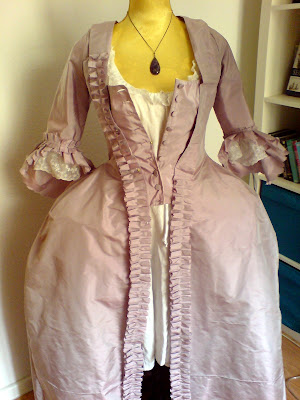
Nachdem ich mich an Schnürbrust, Chemise und Probekleid für meinen Geschmack genügend ausprobiert habe, geht es jetzt an eine Robe à la Francaise im Stil der späten 60er Jahre des 18. Jahrhunderts. Ich habe mir vor einer Weile 11 yards Seidentaft in der Farbe light lavendar aus Indien bestellt und bin mit dem gröbsten schon fertig. Momentan sitze ich an den Verzierungen...
I successfully (kind of) managed to complete a chemise, a corset and a sample dress of cheap ikea cotton, so now it is time to give it a try with silk taffeta. My robe à la francaise is going to be a 60s version of the 18th century. The colour of the taffeta is light lavendar and most of the work is already done. At the moment I'm working on the trimmings, next are the flounces and the petticoat.


I really like that colour! ; )
I successfully (kind of) managed to complete a chemise, a corset and a sample dress of cheap ikea cotton, so now it is time to give it a try with silk taffeta. My robe à la francaise is going to be a 60s version of the 18th century. The colour of the taffeta is light lavendar and most of the work is already done. At the moment I'm working on the trimmings, next are the flounces and the petticoat.


I really like that colour! ; )
Subscribe to:
Comments (Atom)